31 July 2011

d20+ redux

I was a little surprised when I realized how few dice I’ve had out for the current WotC D&D 3e campaign.

With more d20+ dice, I’ve put my ten-siders, my “tens” dice (ten-siders numbered 00–90), and regular twenty-siders in storage. That really lightens up my “in use” bag and the number of dice on the table.

I’ve also swapped all my Gamescience six-siders in favor of my casino-style sixers.

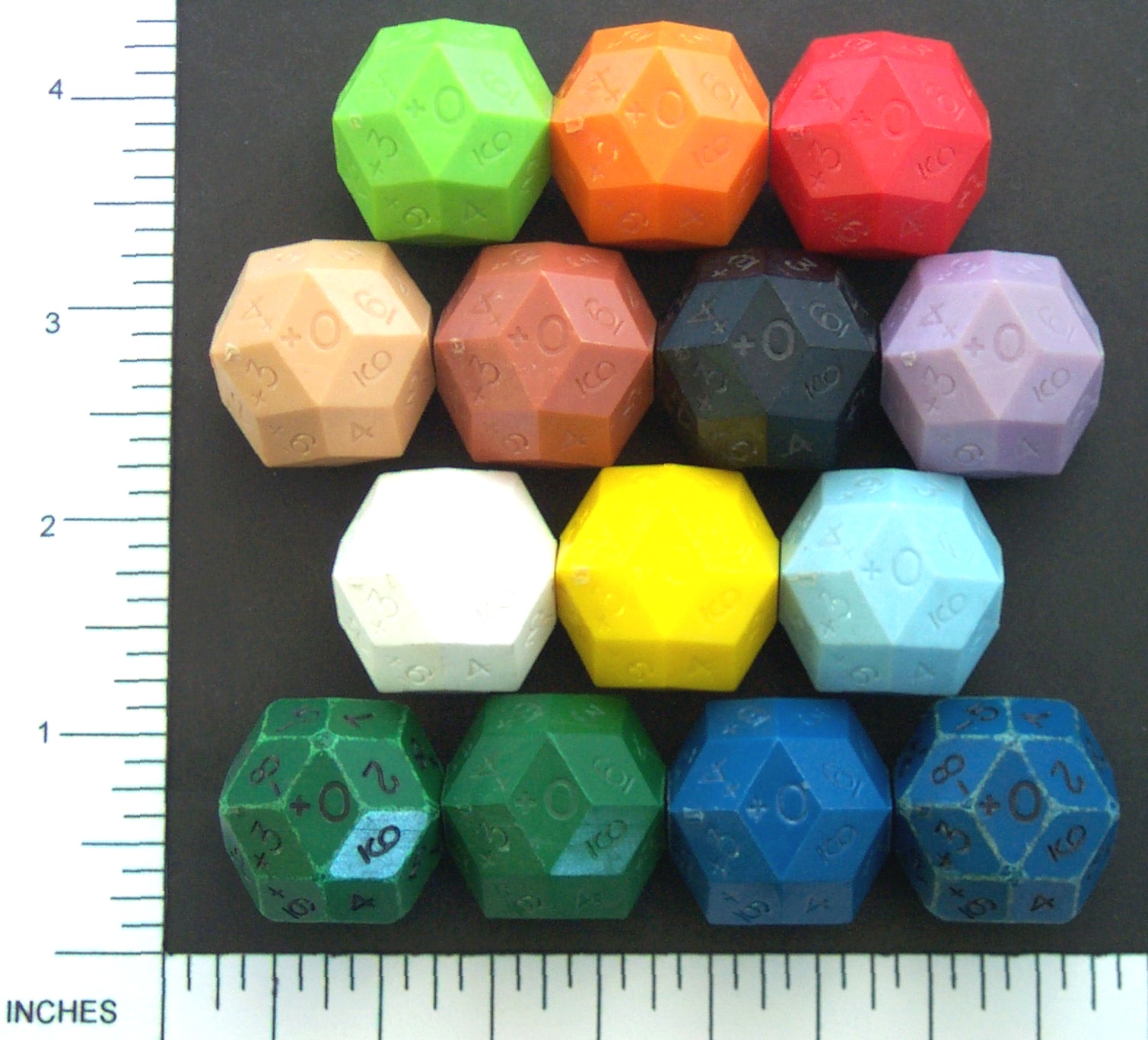
Now I’m thinking that I want to acquire some of those d30s numbered -0 to -9, 0 to 9, and +0 to +9. (d30±) Like these from Kevin Cook’s collection.

30 July 2011

Composite long bow?

AD&D lists a composite long bow. As does WotC’s 3e D&D. Which recently struck me as odd. As I understood it, longbows weren’t composite, and composite bows weren’t long. Am I wrong?

29 July 2011

Real Monopoly

The Campaign For Real Monopoly:

Somewhere along the line someone said, “Let’s just leave out that stupid auction rule; we’ll have much more fun that way.”

Now if parents want to play a crippled game of Monopoly because they’re too scared to teach their children how to deal with interpersonal conflict then fine, that’s their prerogative.

But we’re gamers; we don’t have to descend to their level.

I think there’s something different at work here. When it comes to subterfuge—and lots of games are about subterfuge, younger players are generally going to be at a disadvantage to older players. Though there are certainly exceptions. It’s less about not teaching the kids to deal with interpersonal conflict but trying to put everyone on a more equal footing.

Although, in the matter of auctions in Monopoly, I think it is something different. I think most people just don’t like the auctions themselves. Not the outcome. Not how anyone deals with the outcome. Just the actual auctioning itself. It’s seen as trouble and not fun.

For what it’s worth, I believe the last time I played Monopoly was less than two years ago and the auction rule was used.

22 July 2011

Digital RPG books

In the comments to the Grognardia post, “Books, young man. Books.”, faoladh writes:

When digital books improve considerably, I will consider going there, but for now they are too clumsy (especially for the particular sorts of use that game texts see), there are problems with issues of ownership vs. “licensing”, and they are too expensive for initial entry, among other potential problems.

I can’t say that faoladh is wrong. This is his opinion and experience, and I can’t argue with that. What I can do is look at my own experience and opinion...

I don’t bring books to sessions anymore, unless it is a book I can’t get a digital version of. I just bring my iPad.

The Hypertext d20 SRD site is, for me, better than the books. It has all the open content from several D&D 3.5 books in one location converted into easy-to-read and easy-to-navigate web pages including good hyperlinking. The licensing is clear enough and without issue. (Especially from the “I’m just playing the game” point-of-view.) And, it’s free.

I also really like the SpellbookMaster app that imports the SRD spells into a database.

I bought the Mekton Zeta and Mekton Zeta Plus books from RPGNow. Mekton Zeta Plus I actually bought, downloaded, and used in the middle of a session. They are watermarked PDFs and DRM-free. I don’t remember the prices I paid, but those PDFs are currently $10 and $12. They are pretty clumsy to use, but I have the same issue with the hardcopies. The problem is in the lay-out itself. In fact, the ability to add bookmarks to the PDF may actually make them a bit easier to use.

Not to mention the number of RPG books I can carry with me almost anywhere to read or reference at a moment’s notice.

And it really comes down to the iPad. It was the final piece of the puzzle that made this practical for me.

21 July 2011

AD&D2e Rangers

Why do rangers get two-weapon fighting in second edition AD&D (and later editions)? Well, I’ve heard reasons that claim to be informed by people from TSR, but this is why it made sense to me at the time.

When I looked at the ranger class, I primarily saw Robin Hood. (And perhaps the strongest image of Robin Hood for me then was the Disney movie starring anthropomorphic animals.) My image was of someone who wouldn’t wear heavy armor or carry a shield. Yet, under the AD&D rules (as I and my friends played or misplayed them) the advantage of heavy armor and a shield were too good to pass up. Giving the ranger class two-weapon fighting ability and restricting it to when they were wearing lighter armor gave mechanical reasons for our rangers to look more like my image of the class.

My opinions have changed these days. I have different opinions about armor. I have different opinions about two-weapon fighting. I have different opinions about the ranger class. At the time, however, it made perfect sense to me.

20 July 2011

Operational rules in RPGs

Jeffs Gameblog: LotFP vs DCC

Assuming you aren’t weirded out by the artwork then LotFP shines as pretty much the tightest version of D&D ever. This virtue comes across most clearly in the section devoted to what I call “operations”, i.e. how to open a door or check for traps or crap like that. Most reviews of most D&D descendants (and many whole games!) completely skip this stuff because it's usually boring to read, but in actual dungeoneering play these mechanics are crucial. LotFP delivers the best, most coherent set of operations rules I’ve ever seen.

Let’s consider all the rules in D&D that don’t have to do with combat or magic. Let’s call these the “operational rules”. (Which may be slightly different than what Jeff is talking about above. This is my springboarding off his post.) There’s a surprising amount of them. Even in ye olde original D&D. They are often glossed over when talking about the game, but I’ve come to see them as very important.

These operational rules are what makes D&D an exploration game rather than a combat game.

Take a look at the combat system. Excluding Chainmail and WotC D&D, the D&D combat system is enemic compared to wargames of the era. (Oh, let’s exclude AD&D too just to keep it simple.) And D&D was created by wargamers. That says to me that D&D wasn’t primarily about combat.

Of course, there’s also the fact that D&D is a role-playing game, and that role-playing doesn’t really show up in rules. Yeah, I know you might disagree with me, but whenever I see rules that claim to govern role-playing, I generally see just another mechanical game rather than role-playing. Role-playing happens in the spaces between the mechanics.

19 July 2011

What’s right for you...

Reading this review of Mutant Future, this just struck me as funny. The “to hit” tables get a bulleted mention as a negative. Levels, however, get a “might be a negative to you but not for me” in the concluding paragraph.